
Ending Customer Week on a grateful note
Customer Week is a good reminder of why we do this work. Behind every tax filing, payroll run and advisory project is a relationship built

On 1 January 2027, the mandatory pension contribution in Rwanda rises from 12% to 14% of gross salary. It will keep rising by 2 percentage points every January until it reaches 20% in 2030, split equally between employer and employee.
Most employers have already adjusted to the 2025 reform. What matters now is what each new step will cost, who pays for it, and how quickly it adds up.
At a glance
The contribution base does not change again. Since January 2025 it has been the total gross salary including transport allowance, the same as the PAYE base. Occupational hazards (2%, employer) and maternity leave (0.3% employer and 0.3% employee) also stay the same.
Taken together, the employer’s statutory contributions grow from 8.3% of gross salary in 2026 to 12.3% in 2030, an increase of about 50%.
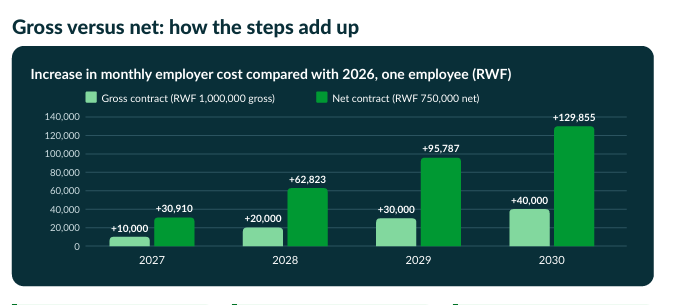
The same rate change costs the employer very different amounts depending on how the salary is agreed.
Monthly, RWF | 2026 | 2027 | 2030 |
|---|---|---|---|
Gross contract (RWF 1,000,000 gross) | |||
Employee take-home pay | 669,635 | 659,685 | 629,835 |
Total employer cost | 1,083,000 | 1,093,000 | 1,123,000 |
Net contract (RWF 750,000 net) | |||
Employee take-home pay | 750,000 | 750,000 | 750,000 |
Total employer cost | 1,220,320 | 1,251,230 | 1,350,175 |
On the gross contract, the employer’s cost rises 3.7% by 2030 and the employee takes home RWF 39,800 less each month. On the net contract, take-home pay is protected, but the employer’s cost rises 10.6% because it must also pay the extra PAYE.
In 2027, every RWF 1 of take-home pay costs the employer between RWF 1.57 and RWF 1.74, for gross salaries from RWF 500,000 to RWF 6,000,000. Employees keep 63.0% to 69.6% of their gross salary, about 1 percentage point less than in 2026.
Our 4-page guide includes the full cost tables to 2030, worked examples for gross and net contracts, and the ratios to use in your budget.
Download the full guide here – CHANGES TO RSSB PENSION CONTRIBUTIONS IN RWANDA_ 2027 TO 2030
Need the impact for your own payroll? We can model your staff costs to 2030 and prepare the message to your employees. Contact us or call +250 792 407 650.
This article is general information, not advice on your specific situation.
Customer Week is a good reminder of why we do this work. Behind every tax filing, payroll run and advisory project is a relationship built

On 25 September 2026, the Official Gazette published four Ministerial Orders (Nº 006 to009/26/10/TC of 24 September 2026). They entered into force on the day